


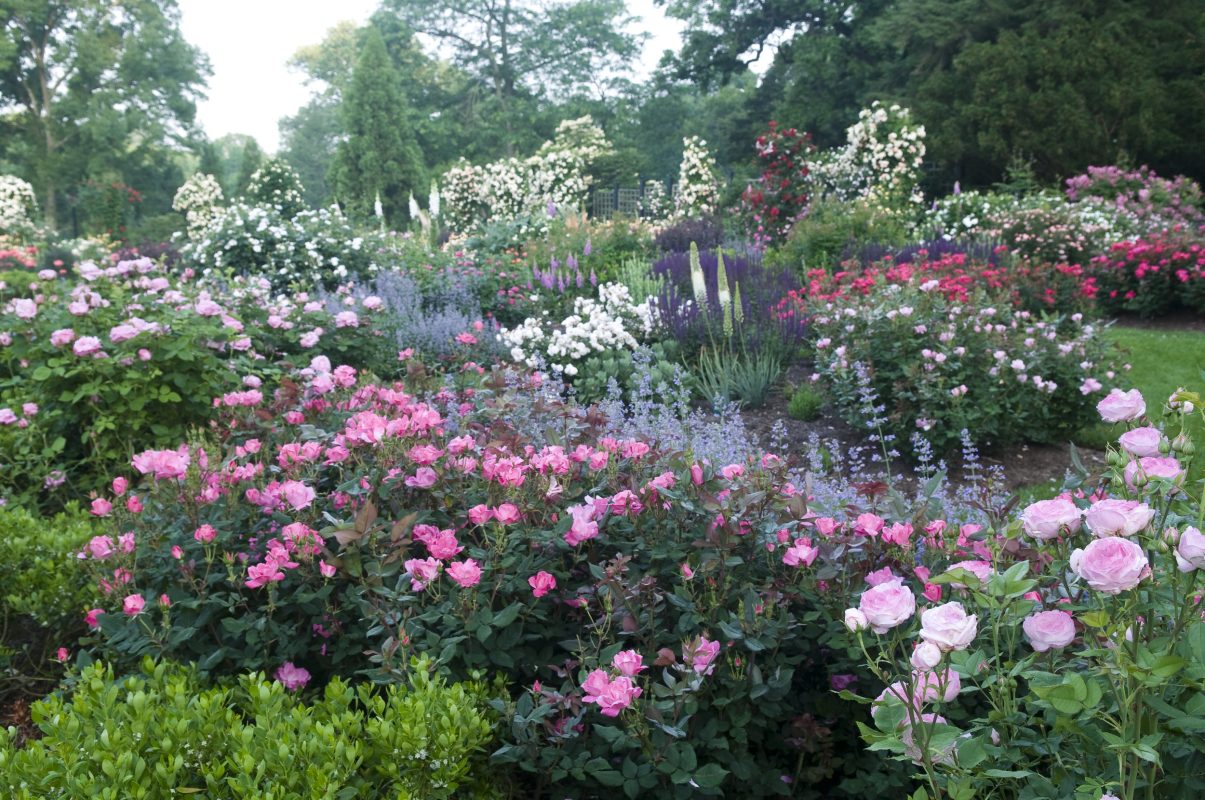
April showers really do bring May flowers!
In the Garden
- There’s no time like the present to get your garden beds ready for planting.
- Amend soil for planting with Lobster Compost. It adds nutrients, improves drainage and breaks up clay, making it easier to establish new plants.
- Use Preen to prevent weeds in your garden beds, so you aren’t spending your summer hand-pulling them out later. (If you’re planning to start seeds in your garden beds, wait to apply until seedlings are at least 2-3” tall).
- Warm-season veggies and herbs are here, so make sure your raised beds are ready.
- Refresh existing soil with Lobster Compost to replenish nutrients that were used up last year.
- For new beds, fill with Coast of Maine Raised Bed Soil, a pre-made soil for raised bed gardening that eliminates the need to make your own. It’s organic and can also be used in containers.
- If you’d prefer to make your own soil, we recommend a ratio of 40% top soil, 40% compost and the remaining 20% a mixture of vermiculite, peat moss and organic matter such as manure and earthworm castings.
- Now that the frost date has passed, it’s safe to start planting warm-season veggies and herbs outside!
- Keep light requirements in mind when selecting your veggies and herbs.
- Most veggies need full sun (6-8 hours per day)
- Most herbs will do well in full (6-8 hours per day) or part sun (4-6 hours per day)
- When picking up your veggie starts, get any supports you’ll need for them. Installing trellises and cages at planting is much easier than trying to get them set up around larger plants.
- Don’t forget the fertilizer!
- GardenTone is a great, organic, all-purpose herb and veggie fertilizer
- TomatoTone is perfect for all tomato plants and it is also organic.
- If you still have cool-season veggies, harvest what you can before they start bolting!
- Warm-season annuals are here and ready for planting in garden beds, containers and hanging baskets!
- Some annuals thrive in sunlight while others need more shade, make sure you’re selecting plants with the same light requirements if you’re planting them together.
- Don’t forget the fertilizer!
- Dynamite is a slow release fertilizer that feeds for up to 9 months.
- FlowerTone is an organic fertilizer, perfect for all flowering plants.
- PlantTone is a wonderful all-purpose fertilizer for all your plants, and it’s organic too!
- If you started warm-season plants inside, harden them off before transplanting them in your garden. Put them outside during the day and then bring them back inside at night for around the week to acclimate to their new environment.
- Most seedlings are ready for transplant once the frost date has passed, and they’ve reached a specific size. Check your seed packet for more information on each seed variety you’ve started.
- It’s now safe to start seeds directly outside.
- Plant summer blooming bulbs, like gladiolus and dahlias, in your garden or containers.
- Keep light requirements in mind when selecting your veggies and herbs.
For the Landscape
- This is the time to find plants at Ken Matthews! We’re stocked with all kinds of perennials, shrubs and trees for your landscaping needs, with more arriving regularly.
- Roses will arrive (if they haven’t already). So, if you’ve been waiting to add some to your garden, now’s the time to snatch them up!
- May is still a great time to plant trees, shrubs and perennials.
- Use Lobster Compost, to amend soil, and Root Stimulant¸ to help roots acclimate and help prevent transplant shock when planting.
- If you have issues with Voles, protect new plants by using mesh Vole Bags to keep the roots safe.
- Remember, summer is on its way and your new plants will need your help meeting their water needs this summer. If you’re planning a fun vacation this summer, check with friends and family if they’ll be able to water your plants for you while you’re gone.
- By mid to late May, spring blooming trees and shrubs will have wrapped up their blooming for the year. Once they’re done, you can prune them as needed.
- Now that spring is in full swing, the pests will be out and about in your garden and landscape. Check plants regularly for signs of problems, it’s easier to control problems if they’re caught early.
- Neem Oil is an organic triple action control (insects, fungus & mites) that is safe to use on edibles as well as ornamentals.
- Bee Safe is a triple action that is safer for bees. While it is safer, it’s still a good idea to spray when bees are not actively visiting the plant in question.
- Rose Shield is also a triple action that’s a bit stronger than Neem Oil, however it is not recommended for use on edibles.
- Rose RX is a systemic insect control that provides up to 6 weeks of protection. It’s an excellent choice if you have a plant that gets the same pest/disease problem each year around the same time.
- Eight Insect Control is a strong insecticide that can kill over 140 types of insects.
- Ladybugs and/or Praying Mantis will be available once temperatures are warm enough to ship and release them. These “good bugs” feed on pest insects like aphids and are the ultimate “organic” pest control.
- The despised Japanese Beetle will be making an appearance soon, get traps up at the first sign of them!
- Make sure you place your traps away from the plants you’re trying to protect!
- The warmer we get (and the higher the humidity), the more often we’ll start seeing fungal problems. Like pests, fungal problems are easier to control when they’re caught early so check regularly.
- Copper Fungicide is an organic fungal control that treats multiple fungal problems including Powdery Mildew and Leaf Spot. It is safe for use on edibles.
- As they are all triple actions, Neem Oil, Bee Safe and Rose Shield, are excellent choices for many fungal problems as well.
- Fertilize your plants! New plantings can be fertilized as they’re planted, and older plants can be fed once they start putting out new growth.
- Follow the recommended feeding schedules for each type of fertilizer, some are one and done while others might want to be applied once a month.
- Use HollyTone for acid-loving plants.
- Apply RoseTone to roses to get them ready for their upcoming bloom
- Perennials and blooming shrubs can be fed with FlowerTone.
- Fertilome Tree & Shrub can be used for all trees and shrubs.
- By May, plants should be fully out of dormancy. If you’re still not seeing any signs of life from a tree or shrub, it most likely hasn’t survived.
- You can preform a scratch test by scratching the bark of a branch with a fingernail. If there’s green underneath the bark, the branch is alive. But if it’s brown, the branch is dead.
- Summer perennials will be starting to emerge. If needed, large perennials can be divided once new growth starts to emerge.
- Mulch around your plants. Mulch helps retain moisture which will be helpful come summer. It also insulates root systems, protecting plants from freezes during winter.
- Follow the recommended feeding schedules for each type of fertilizer, some are one and done while others might want to be applied once a month.
In the Lawn
- As warm-season grass breaks dormancy, make sure to give it a boost with Jonathan Green VeriGreen
- Continue your war on weeds by applying Bonide Weed Beater Ultra or Jonathan Green Lawn Weed Control according to the instructions on the bag. Warm-season weeds will be becoming more and more active as the temperatures continue to rise, and they’re easier to control when they’re young.
- Apply Eight Insect Granular Control now to kill lawn-based pests like ticks and fleas.
- Keep an eye out for lawn fungal problems like brown patch. Once we start warming up and getting more humid, fungal problems can pop up quickly. Infuse Fungicide is a fungal control safe for even newly seeded lawns.
- The window to overseed cool-season lawns is coming to a close. Get cool-season seed down before the middle of the month if you can’t wait until fall to fill bare spots.
- With summer on its way, it’s not recommended to seed a new cool-season lawn at this time. You run the risk of high summer temperatures cooking new grass before it has a chance to develop deep enough roots. Fall is the best time to seed a cool-season lawn.
- May is the start of warm-season seeding and sodding time!
- Before you put down your seed or sod, check the soil pH. If it’s low, raise it with Mag-I-Cal before you get started with renovations.
- Kill off any weeds with WeedBeater Ultra or KleenUp.
- Read the label on your weed controls to see how long you must wait before putting down seed or sod after applying. Some, like KleenUp, are safe to seed after 3-7 days while others, like WeedBeater Ultra, require you to wait 30 days.
- While Ken Matthews Garden Center does not carry warm-season grass seed, we do order Zoysia sod once the temperatures are warm enough and we have enough requests. Click here to learn more about sod and how to get on the list.
For Your Pond
Your pond is now awake and roaring to go!
- Algae will soon start popping up in ponds and fountains everywhere. The true key to control is to prevent it from getting the two main things it needs to thrive: sunlight and nutrients. Pond plants are the easiest solution.
- Floating plants, like water hyacinths, and emergent plants, like lilies and lotus, create a cover over your pond’s surface and prevent algae from getting enough sunlight.
- Marginals, floating plants, submerged plants, and emergent plants all use the same nutrients to grow that algae needs. By adding more plants to your pond, not only do you get a more beautiful pond, but you also starve out the algae.
- Algaecides, like AlgaeFix, kill algae quickly in ponds and fountains. It also works in fountains.
- Clarify murky water with the natural bacteria of Simply Clear.
- Use Chlorine & Heavy Metal Neutralizer whenever you add water to your pond to remove harsh chemicals and metals.
- Microbe-Lift adds beneficial bacteria to improve the conditions of your pond by removing pollutants.
- Once water temperatures are consistently above 60°F,° you can begin feeding your fish with Koi Vibrance Fish Food.
Miscellaneous
- Fill hummingbird feeders and set them out.
- Give your houseplants a little vacation by bringing them outside for summer.
- It’s also a good time to repot your houseplants, and doing it outside means less mess inside!
- If you have issues with moles and voles, apply Mole Max to drive them out.
- One of the worst feelings has to be seeing the deer chow down on your new plants. If you have deer problems, protect your plants with deer repellents like Liquid Fence and Deerscram!